



Why do societies continue to reproduce ways of living that undermine their own ecological and social foundations?
I explored this question back in 2010 in my chapter “The Cultural Dimension of Un/Sustainability: Delicate Distinctions between Societal Survival and Collapse.” The chapter was published in Sigurd Bergmann and Dieter Gerten (eds.), Religion and Dangerous Environmental Change: Transdisciplinary Perspectives on the Ethics of Climate and Sustainability, Volume 2 of the series Studies in Religion and the Environment, published on behalf of the European Forum for the Study of Religion and the Environment.
My chapter explores why societies can remain locked into unsustainable patterns even when the need for change becomes increasingly evident. It examines the cultural and social forces that shape societal development, focusing on complexity, order, dynamics and evolution. Its central question is what makes social systems resistant to change, and under which conditions culture can instead become a force for sustainability.
The central thesis remains highly relevant to my work today: sustainability is not only a question of technologies, resources or policies. It is also a question of culture, social relations and power. If culture is the blueprint of societal development, it can shape both sustainable and unsustainable pathways. Despite pointing in opposite directions, however, these pathways may remain deeply entangled in the ambivalences and contradictions of social practices.
Read the full text:
Full reference:
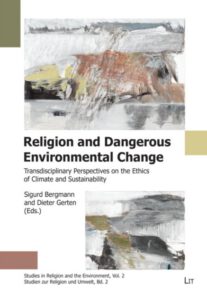
- Brocchi, Davide (2010): “The Cultural Dimension of Un/Sustainability: Delicate Distinctions between Societal Survival and Collapse.” In: Sigurd Bergmann & Dieter Gerten (eds.), Religion and Dangerous Environmental Change: Transdisciplinary Perspectives on the Ethics of Climate and Sustainability. Studies in Religion and the Environment, Vol. 2. Berlin/Münster: LIT Verlag.